
The glucose gap
2025 State of Wellness report
In 2025, Americans are more determined than ever to listen to their bodies.
They’re trusting physical signals, embracing wearable technology, and seeking personalized data. Yet they’re missing a powerful metric that could transform their health.
Our research reveals something remarkable: Most Americans don’t know how glucose shapes their daily health.
But a growing community is discovering its power. Through continuous glucose monitors (CGMs), they’re uncovering surprises about their bodies and transforming “Ah-ha” moments into real change.
What sets CGM users apart is what they are achieving: the healthy changes so many Americans want for themselves.
We’re thrilled to share these findings with you and start an urgent conversation about bridging the gap between how Americans feel and what their bodies are telling them.
The missing link in metabolic health


A metabolic health crisis
88% of Americans have suboptimal metabolic health.


The glucose gap
But 4 out of 5 Americans don't see glucose as relevant to their health goals.


Goals are in for 2025
9 out of 10 Americans are setting health goals this year.


Surprising CGM insights
58% of people using Lingo CGMs found “healthy” foods had a surprising impact on their glucose.


New insights, new habits
95% of Lingo members are building a new habit based on what they learned.


Reducing sugar
37% of Americans want to eat less sugar this year. 52% of Lingo members are making this change.
What are Lingo members learning?
82%
of self-described "glucose experts" had at least one surprising discovery after using a CGM.
58%
say a "healthy" food caused a larger-than-expected glucose spike.
1 in 3
found stress affected their glucose more than expected.
50%
are cutting back on carbs. Nationwide, 19% of Americans plan to eat fewer carbs this year.
76%
of those who use Lingo to manage hunger say it's effective.
3 in 4
agree glucose tracking has been effective in helping them achieve their health goals.
The big picture
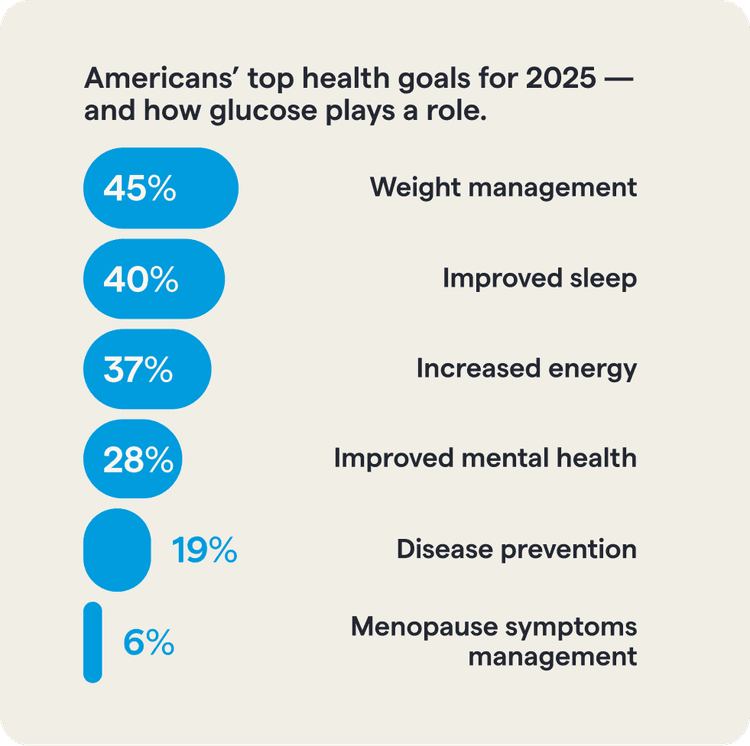
Glucose is one of the primary sources of energy for the body, fueling everything from your brain to your muscles. When this process runs smoothly, people are metabolically healthy — but some people don't tolerate rises in glucose as well as others.
88% of Americans have suboptimal metabolic health, which could increase the risk of serious disease in the long run.
Lingo members share their learnings


- "I don't do naked carbs or sugar — instead I add protein, fat, and fiber, to balance my meal."
- "Now I understand that moving is more than just burning calories. It also lowers glucose after a meal."
- "Some things that I thought were relatively healthy sent my glucose off the chart. I'm throwing out many old assumptions."
Download the report


Our inaugural State of Wellness reveals Americans' goals for 2025 — and more.
- The powerful health data Americans are missing
- Foods that lead to surprising glucose spikes
- The top habits CGM users are building
Download now