CGMs vs. BGMs: comparing interstitial fluid and blood glucose readings.
Ever compared CGM and BGM readings and noticed they don’t match? Glucose can differ depending on where it’s measured. Here’s a simple guide to why that happens and what it means for you.


Published
April 27, 2026
Read time
7 minutes

Here’s one of the top questions we get at Lingo: Why is my CGM reading different from my BGM — and what does that difference actually mean? The good news is that doesn’t mean anything is wrong with you or your tech. Both blood glucose meters (BGM) and continuous glucose monitors (CGM) meet their own accuracy expectations but still have some variability for several reasons.
Let’s break it down
Whether you’re using a BGM, a CGM, or both, each delivers in different ways.
BGMs give you a glucose “snapshot” from your blood at that moment, while CGMs show you a continuous glucose “story” from the interstitial fluid between your cells all day.
Glucose reaches blood before interstitial fluid (ISF). Because CGMs measure glucose in ISF, the two readings can differ, especially when glucose changes quickly. Research shows that ISF readings still accurately reflect overall glucose trends.1
Many people find CGMs easier for regular monitoring because they don’t require finger pricks, while BGMs remain useful for quick confirmation during fast changes or when symptoms don’t match what your CGM shows.2
Start Lingo today for just $54
Learn how your body responds to food and exercise with a 2-week plan*, no commitment.
Buy now
Glucose in blood vs. interstitial fluid: two valid places to track
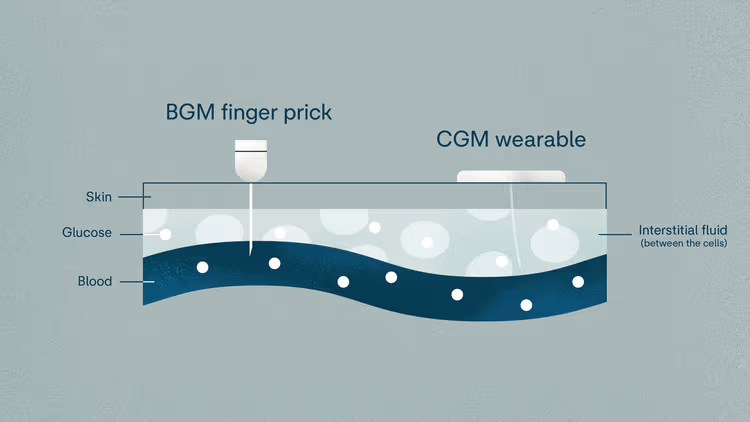
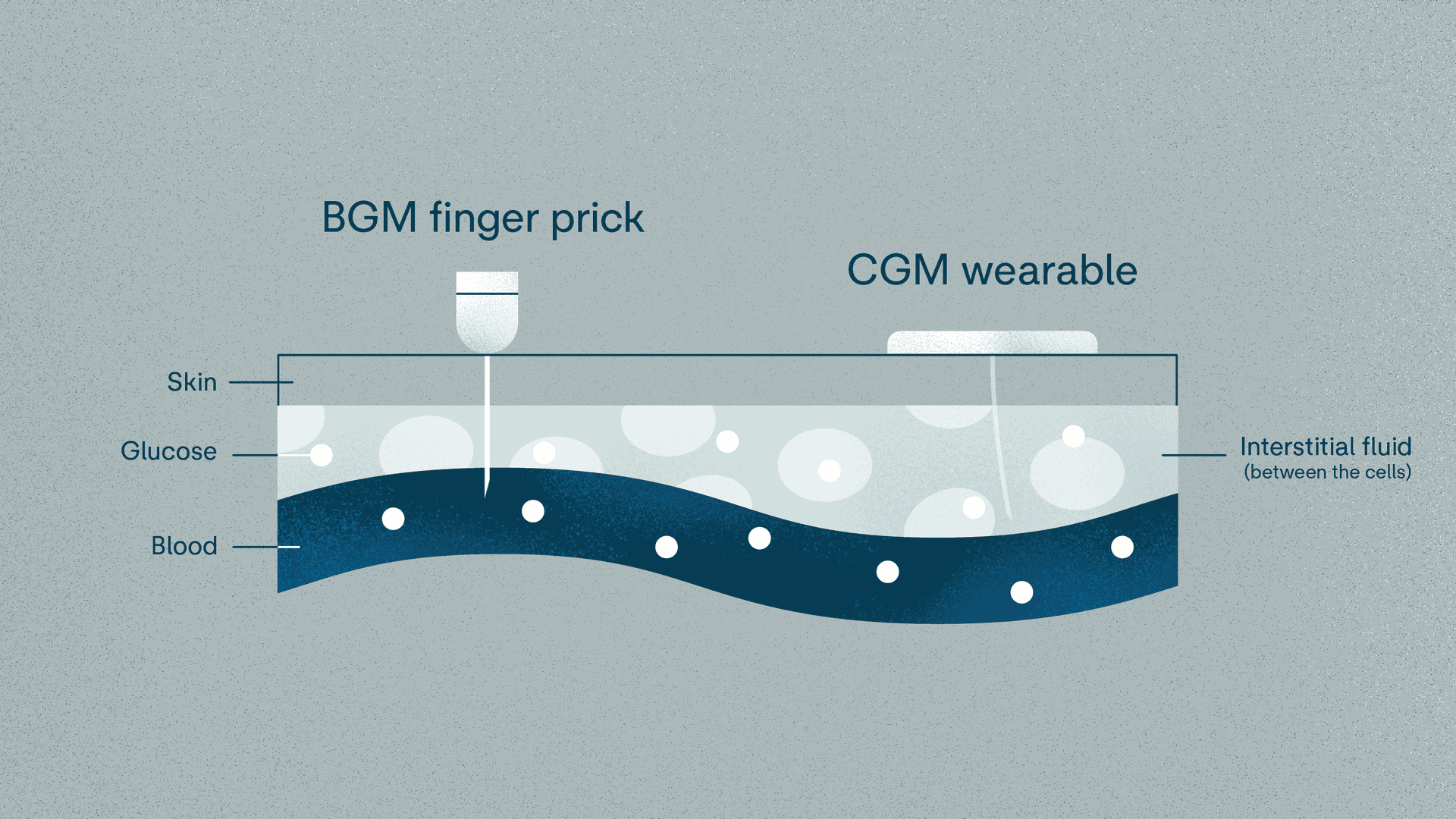
Glucose is a major energy source in the body, and most of it comes from the foods we eat — primarily carbohydrates and sugars. When these nutrients are digested and absorbed, glucose enters the bloodstream first before moving into the interstitial fluid (ISF) surrounding your cells.
As glucose moves from blood to ISF, it can be measured through a continuous glucose monitor (CGM). A CGM uses a small, flexible filament housed inside a biosensor — the small circular disc worn on the back of your arm. The filament rests just under your skin.
Your Lingo biosensor continually sends ISF glucose data to the Lingo app, giving you a real‑time “story” of how your daily habits — such as choices about meals and movement — impact your glucose minute‑by‑minute.
Why CGM and BGM readings can differ
Here’s the magic of biology: glucose reaches your blood before it reaches the interstitial fluid, so the two readings track together, but they won’t match perfectly every second. That’s normal.
A BGM gives you a moment-in-time “snapshot.” While a CGM gives you the ongoing “story.” Just like any story, what you see depends on where and when you read it.
The lag between the two readings is most noticeable when glucose is changing quickly — like right after a meal, during a workout, or when you’re under stress. Even when glucose is steady, small differences between blood glucose and ISF glucose are expected because they live in different spaces inside the body.
Even when readings vary, there’s no need to worry. Lingo meets accuracy expectations for how close CGM glucose values must be to blood glucose — more than nine out of ten readings within 20% or 20 mg/dL of benchmark blood glucose values measured in a lab.3,4 Because CGMs give you continuous readings, you’re able to see trends and patterns that a finger prick won’t capture.
Other reasons your readings may not match
Life happens. So, everyday factors can affect readings from either a CGM or a BGM:
Pressure on the sensor can temporarily lower CGM glucose values — for example, sleeping on the sensor.
Taking more than 1000 mg of Vitamin C per day may falsely alter Lingo CGM glucose values. (Other CGMs may have different substances that affect readings.)
Expired test strips or a CGM past its expiration date can affect accuracy.
Not having clean, dry hands before testing can cause erroneous BGM readings.
CGMs can show slightly more variability on the first day the sensor is applied.
These differences are normal and easy to troubleshoot once you know what to look for.
Lab blood glucose tests
This is the gold standard for measuring glucose — the benchmark against which all other tools are compared. These tests are typically done by your doctor or in a lab setting, where accuracy and quality controls are strictly regulated.
Fasting blood glucose tests, oral glucose tolerance tests, and random (non-fasting) glucose tests combined with symptoms — can be used to diagnose prediabetes or type 2 diabetes. Because fasting glucose can vary day to day, diagnosis requires two abnormal fasting results on different days.
But we can’t go to the doctor daily to monitor our glucose — which is why everyday tools like BGMs and CGMs can help us keep track more often.
Blood Glucose Meters (BGMs): fingerstick
Home glucose meters have accuracy expectations: 95% of readings must fall within ±15 mg/dL (for readings below 100 mg/dL) or ±15% (for readings above that).4,5 These are reliable “snapshots”, often used upon waking, before meals, after meals, or when symptoms occur.
Errors can occur — so if your fingerstick reading seems quite different from your CGM reading, make sure your hands are clean and dry, your strips haven’t expired, and your device is stored properly.
Continuous Glucose Monitors (CGMs): everyday wearables
The FDA created the iCGM designation — the strictest accuracy standard for continuous glucose monitoring.
To earn this designation, CGMs must meet range‑specific and rate-of-change-specific accuracy performance rules in clinical studies, and overall, more than 87% of the readings must be within 20% of the lab blood glucose value.4
Lingo is FDA‑cleared as an over-the-counter iCGM, meeting these stringent accuracy criteria and available to adults not using insulin — no prescription needed. Lingo uses the same foundational technology as FreeStyle Libre 2 sensor6, also designed by Abbott.
An OTC CGM that meets the highest standard? That’s an everyday wearable experience worth relying on.
Why you may use a BGM with a CGM
If you feel low, but your CGM reading looks normal — or the other way around — a fingerstick BGM test can help confirm what’s happening, especially if your healthcare provider has advised checking your blood glucose.
Because CGMs measure ISF and may lag behind blood during rapid changes, a fingerstick can give you clarity in those fast‑moving moments. Daily events like meals and workouts can cause rapid glucose shifts where readings between BGMs and CGMs may briefly disagree.
But for gathering countless insights, understanding habits, and learning what lifestyle changes can benefit your metabolic health, a CGM is the way to go.
The big takeaway
Your CGM isn’t “wrong.” It continuously and painlessly* shows you the full “story” of what’s happening with your glucose, rather than a single “snapshot” in time.
The best bit? Because it’s OTC, you get glucose insights 24/7 without drawing blood or visiting your doctor. With Lingo, you can see your glucose response to food, exercise, stress, and sleep, find what works for your unique body, and build the habits that help you feel your best.
Click here to watch BGMs vs. CGMs: Know the difference on our YouTube channel.
* In a study conducted by Abbott, 91.6 % of users surveyed (n=119) agree that it was painless to apply the biosensor. Data on file, Abbott.
The Lingo Glucose System is intended for users 18 years and older not on insulin. It is NOT intended for diagnosis of diseases, including diabetes.
The Lingo program does not guarantee that everyone will achieve the same results as individual responses may vary. Consult your healthcare professional before making changes to your diet or exercise regimen or if you have an eating disorder or a history of eating disorders.
© 2026 Abbott. All rights reserved. The biosensor shape and appearance, Lingo, and related brand marks are marks and/or designs of the Abbott group of companies in various territories. Other marks are the property of their respective owners.
ALB-2604918
Published
April 27, 2026
Read time
7 minutes


Pamela Nisevich Bede, MS, RD, CSSD, LD, is a certified specialist in sports dietetics and an expert in nutrition communications. Pam earned her Bachelor of Science degree in Dietetics from Miami University and a Master of Science in Medical Dietetics from The Ohio State University. While at Abbott Nutrition, Pam was the Global Nutrition Lead at Zone Perfect Nutrition and Ensure and was previously the Manager of Nutrition Marketing at EAS Sports Nutrition.
Suggested articles
Does metabolism actually slow down with age?
What you need to know about how aging impacts your metabolism, according to research.
December 09, 2024|10 minutes
Why wear a continuous glucose monitor if you don’t have diabetes?
Research has shown that there are benefits of limiting glucose spikes, which can be monitored by using a CGM, even if you don’t have diabetes. Using a CGM can help you gain insight into your glucose levels and limit glucose spikes.
December 09, 2024|5 minutes